DVD-quality lessons (including tabs/sheet music) available for immediate viewing on any device.
Take your playing to the next level with the help of a local or online resonator guitar teacher.
Monthly newsletter includes free lessons, favorite member content, resonator guitar news and more.
Premier Sponsors




|
Please note this is an archived topic, so it is locked and unable to be replied to. You may, however, start a new topic and refer to this topic with a link: http://www.resohangout.com/archive/59361
l2t - Posted - 09/26/2024: 12:46:08
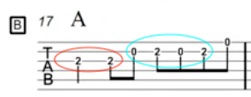
Working on Old Joe Clark and wondering the best way to block on the first measure of the B part, or any general going to higher strings in open positions without letting the lower strings continue to ring.
A couple notes on the 3rd string (red oval) and then go to the 2nd string (blue oval). It doesn't sound great when I lift the bar to play the open 2nd string and the 3rd string rings. It almost comes out like a pull off on the 3rd string. Muting with the left hand doesn't work great as I could mute the 2nd string. I supposed pick blocking is the way to go but I'm not sure what combination of figures to use so I can pick block. I can block the 3rd string with my thumb and use the index on the 2nd string open. But then I want the thumb again to hit the down beat on 2nd string 2nd fret and can't get it off the old string fast enough. Should I just practice and get that faster, or maybe use a different combination of fingers?
And of course, the same thing happens again when going from the 2nd string to the 1st. Blue oval to the open 1st.
l2t - Posted - 09/26/2024: 13:42:21
I was thinking one thing I could do is simply assign a finger to a string -- 3-t, 2-i, 1-m. Then I could always block with the same finger. I wonder if that would slow down speed as then I could do something like t-i-t-i on the same string.
BrianMac - Posted - 10/02/2024: 17:14:46
@ l2t
I wondered how I’d pick this so while practicing today I played this phrase, actually not even knowing what my hand would do. I had tried to imagine it prior to picking it with my guitar in hand and couldn’t visualize it.
Here’s how I did it, and I’m not saying it’s correct or the only way, but the way that my hands did it.
Using a tilted bar in order to play single notes, and in order of each note used: thumb, thumb, thumb, hammer on, hammer off, hammer on, thumb.
I leave my middle finger behind the bar after I thumb the first note and lift the bar. That middle finger mutes the 3rd string. I also leave that middle finger behind the bar after the 2nd hammer on.
These things can be learned by rote I guess, but after awhile (a long while) your hands just start to do it. Melody specific fiddle tunes will force a person to confront blocking and picking choices big time IMO.
I’d be curious to hear how someone else picks this. More than one way to skin a cat.
Edited by - BrianMac on 10/02/2024 17:15:56
JC Dobro - Posted - 10/02/2024: 17:54:23
I do what Brian does, except it is my left ring finger that mutes out the 3rd string after the note is picked. It does require lifting the bar after the note is struck. I also (like Brian) use my thumb to pick the first 2 notes.
If you are precise with your bar hand trailing finger(s) (either ring or middle, depending on how you hold the bar...), you can mute a specific string without affecting adjacent strings. It comes with practice.
Edited by - JC Dobro on 10/02/2024 17:56:53
BrianMac - Posted - 10/02/2024: 19:12:32
Ha! I mute with the ring finger behind the bar also, like Jamie mentioned. Not the middle finger. The middle finger is already too busy gripping the bar!
Not sure what I was thinking there.
At any rate, that kind of raking pattern low to high can often be done with only a thumb and hammer ons/pull offs.
JC Dobro - Posted - 10/03/2024: 05:57:22
quote:
Originally posted by BrianMacHa! I mute with the ring finger behind the bar also, like Jamie mentioned. Not the middle finger. The middle finger is already too busy gripping the bar!
Coincidentally, up until a few weeks ago, I was sneaking the middle finger down the side of the bar and onto the strings for damping/muting. I noticed many players do this, whether they are aware of it or not.
I recently switched over to a bar grip whereby the middle stays firmly on the side of the bar, and only the ring finger and pinky contact the strings. (Andy Hall is a textbook example of this). I fiind it allows for a more robust bar hand "unit" that facilitates faster playing.
OK, back to the OP's blocking question...
Terms of Use | Privacy Policy | Privacy Consent (EU/GDPR Only)
Copyright 2026 Reso Hangout. All Rights Reserved.